Why a Balcony Feels Bigger When the View Has a Pause
A balcony feels bigger when its view has a pause: use one clear focal point and an open sightline to make a compact outdoor space feel composed.
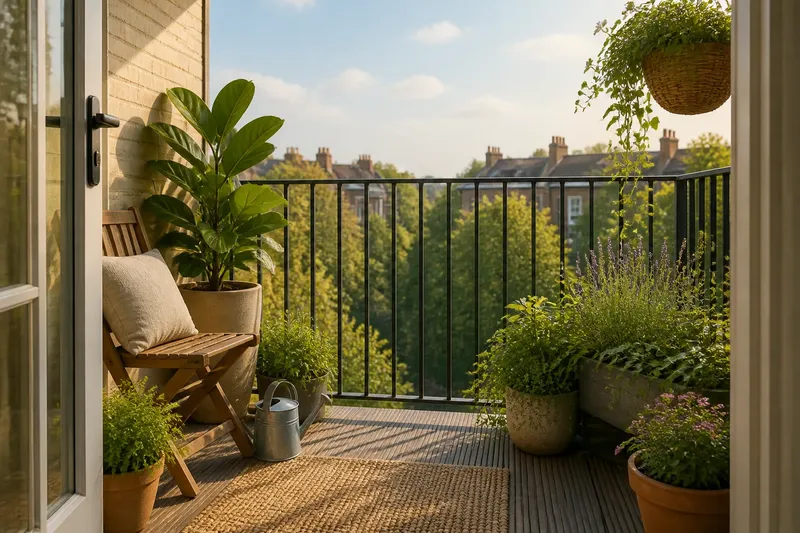
You step onto a narrow balcony and your eye catches a watering can, a chair leg, a cluster of leaves, and the railing beyond. A balcony feels bigger when the view has a pause: one clear focal point gives the eye somewhere to rest, while an open sightline lets it travel across the space.
This is not a reason to strip the balcony bare or buy a feature object. It is a way to arrange what you already have so that a plant, a view through the rail, or a simple patch of wall can read clearly instead of competing with nearby details.
What does a pause in a balcony view mean?
A pause is a relatively uncluttered area between things that draw attention. It might be a visible stretch of railing, a plain wall beside a leafy plant, or open floor between the doorway and a small chair. The eye can move from one point of interest to the next without meeting a new object at every turn.
In a compact space, a focal point is the element that first catches attention and gives the view a center. It could be a single tall plant, a distinctive leaf shape, or a distant tree visible beyond the rail. The best focal point is often something already present, not an extra decoration that needs its own place.
Look at the balcony from the doorway, since that is often the first view into it. Notice whether several objects compete for attention at once, then identify one element you would like to notice first.
Why can an open sightline make a small balcony feel larger?
An open sightline gives the eye a route across the balcony rather than stopping it at a dense arrangement. When you can see from the doorway toward the railing, or through a gap between plants to the view outside, the space reads as connected rather than divided into small pockets.
This effect depends on what blocks the view, not simply on how many objects the balcony contains. A few bulky items placed across the main line of sight can make the space feel more enclosed than several smaller items kept to the edges. Conversely, a balcony with many plants can still feel composed if their placement leaves a readable path for the eye.
Try standing at the entrance and tracing a visual line toward the far edge. If a tall pot, folding chair, or hanging basket interrupts it, consider shifting that item to one side before deciding that it needs to go.
Where should the focal point sit?
Place the focal point where it is visible from the doorway or the seat, but avoid making it a barrier across the main view. A plant near a side wall can draw attention without blocking the railing. A view beyond the balcony may already be the strongest focal point, in which case the arrangement should frame it rather than compete with it.
Height changes where the eye travels. A taller plant can give the view a clear marker, while a low grouping may leave more of the background visible. The choice depends on the balcony’s proportions and what is beyond it: a tall feature can help a blank wall, but it may obstruct a pleasant outlook or feel imposing near a narrow entrance.
Imagine your balcony has a door at one end, a chair against the side wall, and a broad-leaved plant beside the railing. If the plant blocks the view from the doorway, moving it beside the chair could leave the center open and make the plant a deliberate focal point. The observable change is a clearer view across the floor and toward the rail, not more usable area created by magic.
How can plants create a pause without adding more objects?
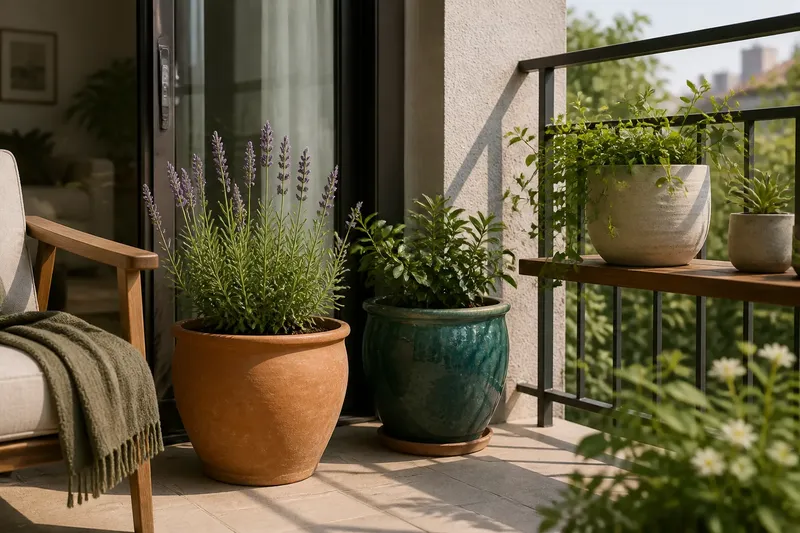
Use the shape and spacing of existing plants to set a visual rhythm. A large leaf can act as the focal point, while smaller plants grouped nearby form a supporting edge. Leave a little visible wall or railing around the group so its outline remains distinct.
Repetition can help the arrangement feel settled, but every pot does not need to be identical. What matters here is the gap between the group and its surroundings: plants pressed against several other objects may merge into one busy mass, while a modest separation lets each area read more clearly.
Consider the plant’s mature shape and its needs before moving it. A position that looks visually tidy still has to suit the available light, airflow, and room for growth; choose among locations that are appropriate for the plant rather than forcing it into a spot for appearance alone.
What should stay out of the main sightline?
Keep the visual route from the doorway toward the far edge as open as the balcony allows. That does not mean leaving the floor empty. It means putting practical items, such as a watering can or folded chair, where they do not become the first thing the eye meets.
Look especially at objects that sit at different heights. A hanging planter may interrupt the view at eye level even when the floor is clear, and a railing planter can obscure an outlook from a seated position. Check the view both standing and sitting before settling on a placement.
Balcony rules and product instructions may determine where planters can safely be secured; follow those directions when choosing a location. For the visual arrangement, begin with the doorway view and adjust only what interrupts it.
How do color and background affect the pause?
A quiet background makes a focal point easier to see. Green foliage against a plain wall, for example, has a clear outline; several bright objects clustered together can compete with one another. This does not mean the balcony must be neutral. A single vivid flower or colorful pot can serve as the focal point if nearby areas offer some visual breathing room.
Take account of what lies beyond the railing. If the view already includes strong colors or a busy building facade, adding several high-contrast objects at the same point may make the scene feel crowded. A simpler arrangement near the edge can let the outside view carry more of the visual interest.
Color also changes with light. A plant that stands out in the morning may blend into a shaded background later, so observe the balcony at the times you usually use it and choose the focal point accordingly.
How do I arrange a balcony view around one focal point?
Which view should I use to judge the arrangement?
Start at the doorway, then check the view from your usual seat. The doorway shows how the balcony reads as you enter, while the seated view reveals whether a railing planter or tall object blocks the outlook.
Should the focal point be centered?
Not necessarily. A focal point slightly to one side can feel more natural and leave the middle of a narrow balcony visually open. Center it only if the surrounding space supports that arrangement and it does not obstruct movement or the view.
What if the balcony has no attractive view beyond the rail?
Use a simple feature within the balcony, such as a well-shaped plant or a patch of clear wall, as the point of focus. A calm, legible view can feel composed even when the background is a neighboring wall or a service area.
How can I tell if there is enough visual space?
Look for at least one uninterrupted route for the eye, such as a clear stretch from the entrance toward the railing or a visible gap around the focal plant. If the first glance lands on several competing objects, move one item aside and look again.
How can the arrangement change with the season?
A balcony’s focal point does not have to stay fixed. A flowering plant may attract attention during one part of the growing season, while a plant with strong foliage or an open view becomes more prominent later. Let the most visually distinct element take the lead rather than keeping an arrangement unchanged out of habit.
Seasonal changes can also alter the background. A leafy tree beyond the rail may provide a soft backdrop in warm weather and reveal more buildings or sky when its leaves drop. Observe what has become more visible, then shift a nearby pot if it starts competing with that view.
Keep the same basic question in mind: what should the eye notice first, and what should remain open around it? The answer can change as plants grow, bloom, or become less prominent.
What is the simplest way to check the result?
Step inside, look through the doorway, and name the first thing you notice. Then sit in the usual seat and check whether you can see past the focal point toward the background. These two views reveal whether the arrangement works for entry and for everyday use.
If the balcony still feels busy, do not immediately add a screen, shelf, or decorative object. Move one competing item to an edge, clear a small patch of railing or wall, and look again. A visible pause is often made by subtraction and placement, not by filling an empty corner.
A balcony feels bigger when its view has a pause because the eye can take in the whole arrangement instead of stopping at each object. Let one plant or view lead, keep a clear sightline beside it, and leave enough open space for that focal point to be seen.